4.1 The Building Blocks: PipeOps
The building blocks of mlr3pipelines are PipeOp-objects (PO).
They can be constructed directly using PipeOp<NAME>$new(), but the recommended way is to retrieve them from the mlr_pipeops dictionary:
## # A tibble: 42 x 8
##    key   packages input.num output.num input.type.train input.type.pred…
##    <chr> <list>       <int>      <int> <list>           <list>
##  1 boxc… <chr [1…         1          1 <chr [1]>        <chr [1]>
##  2 bran… <chr [0…         1         NA <chr [1]>        <chr [1]>
##  3 chunk <chr [0…         1         NA <chr [1]>        <chr [1]>
##  4 clas… <chr [0…         1          1 <chr [1]>        <chr [1]>
##  5 clas… <chr [1…        NA          1 <chr [1]>        <chr [1]>
##  6 clas… <chr [0…         1          1 <chr [1]>        <chr [1]>
##  7 cola… <chr [0…         1          1 <chr [1]>        <chr [1]>
##  8 coll… <chr [0…         1          1 <chr [1]>        <chr [1]>
##  9 copy  <chr [0…         1         NA <chr [1]>        <chr [1]>
## 10 enco… <chr [1…         1          1 <chr [1]>        <chr [1]>
## # … with 32 more rows, and 2 more variables: output.type.train <list>,
## #   output.type.predict <list>
Single POs can be created using mlr_pipeops$get(<name>):
or using syntactic sugar:
Some POs require additional arguments for construction:
learner = mlr_pipeops$get("learner")

# Error in as_learner(learner) : argument "learner" is missing, with no default argument "learner" is missing, with no defaultor in short po("learner", lrn("classif.rpart")).
Hyperparameters of POs can be set through the param_vals argument.
Here we set the fraction of features for a filter:
filter = mlr_pipeops$get("filter",
  filter = mlr3filters::FilterVariance$new(),
  param_vals = list(filter.frac = 0.5))
or in short notation:
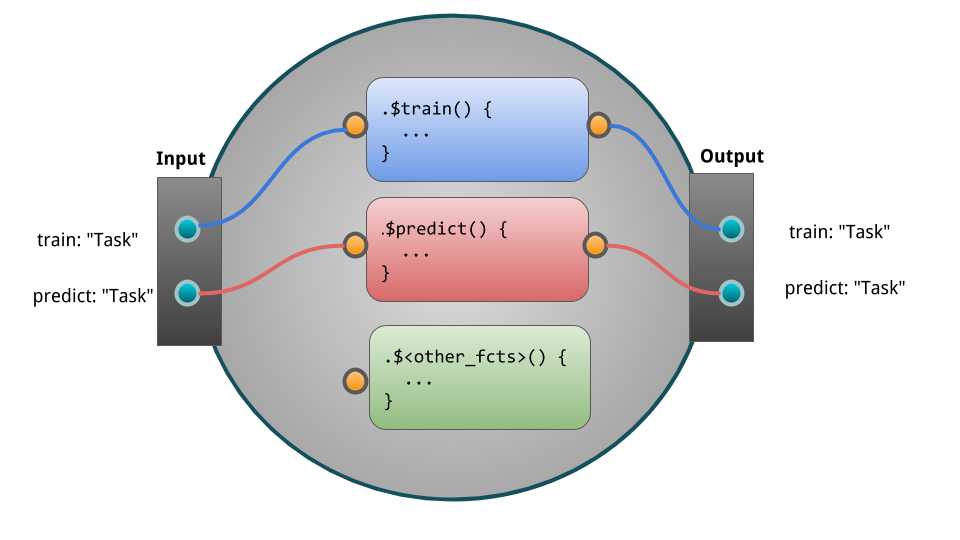
The figure below shows an exemplary PipeOp.
It takes an input, transforms it during .$train and .$predict and returns data: